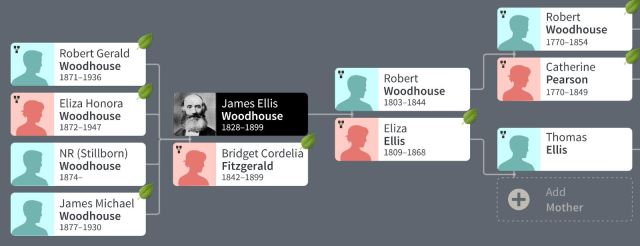
James Ellis Woodhouse is the oldest son of Robert Woodhouse and Eliza Ellis. His earliest encounters are detailed in their chapter of the family tree blog and his story continues here at the discovery of gold on the Teviot River.

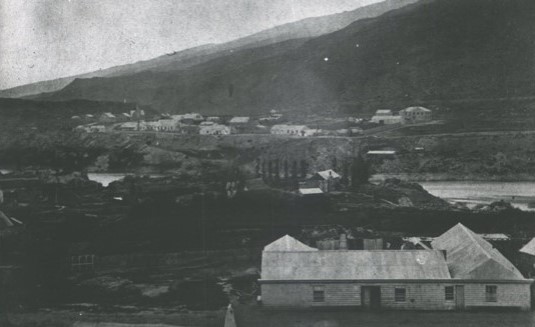
History in its many versions tells us that James and Frank Woodhouse, their step-father George Corden and Andrew Young found the first gold in the Teviot, with Miners Rights being issued at Mt Benger on 8 October 1862 to all four. They were on their way from Gabriel’s Gully to the Dunstan rush along the east bank of the Molyneux (Clutha) River when they came across the Teviot river. After crossing the river they took time to dry out their clothes, and while waiting they filled in time with some tentative prospecting of the river. Their results were so good that they decided to stay put, pegged out their claims at the junction of the two rivers, and so began gold mining in the area. They then stayed as pioneer settlers in the district to be later known as Roxburgh.

Shortly afterwards James Woodhouse and George Corden went into partnership in owning the Union Hotel for several years, with Eliza doubtless being in charge of the housekeeping and catering until her death in 1868. George Corden died later the next year, however, James kept the hotel for approximately 10 years.
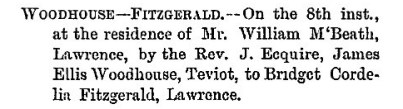
When James was 31 years old he falls for the local teacher Bridget Cordelia Fitzgerald, who was from County Clare in Ireland, and on 8 June 1869 they marry at Lawrence.
During their thirty years together they have four children together and three grew to live long and successful lives – Robert Gerald (1871-1936), Eliza Honora (1872-1947), an unnamed stillborn child in 1874 and James Michael (1877-1930).
Roxburgh did not have a Catholic church until 1870, therefore, Mass was usually celebrated in the comercial room of James and George’s Hotel. This was serviced by Dunedin and Invercargill priests, including Father Moreau who was to perform their marriage in 1869.
After about 10 years as the local publican James shifted his attention to local politics as a councillor on the district’s first council, as well as running his mining interests. By the mid 1880’s he divests those interests and totally focuses on farming, both dairy and sheep.
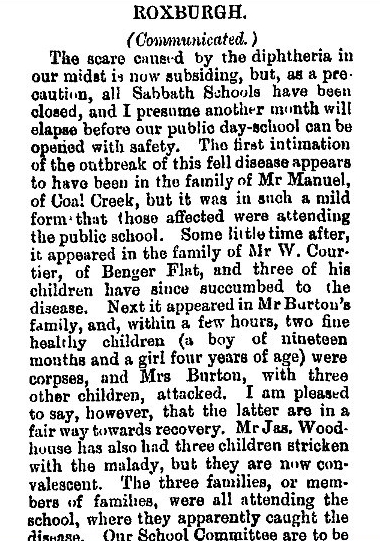
At about that time there was a major health scare in the country, diphtheria, and this caused the closing of schools for weeks. This disease killed between 5 to 10% of those affected and fortunately James and Bridget’s children, who all became infected, recovered back to normal health.
In the following year Bridget suffers a breakdown and was hospitalised at Seacliff Lunatic Asylum in Dunedin for six weeks. Her condition was described as being very restless and excited, talked incoherently and reacted with random violence towards others. She was professionally diagnosed as being a lunatic by two independent professionals causing her to be committed. James agreed to pay 10s and 6p per week for her maintenance and care. Fortunately she recovered and was discharged 1 July 1885.
James dies on 16 June 1899 at his farm at Woodland Farm in Roxburgh, and Bridget passed away six weeks later on 29 July 1899.

 Our Golden Pioneers